Arts + Culture
Beyond Gangnam Style—the Korean Wave
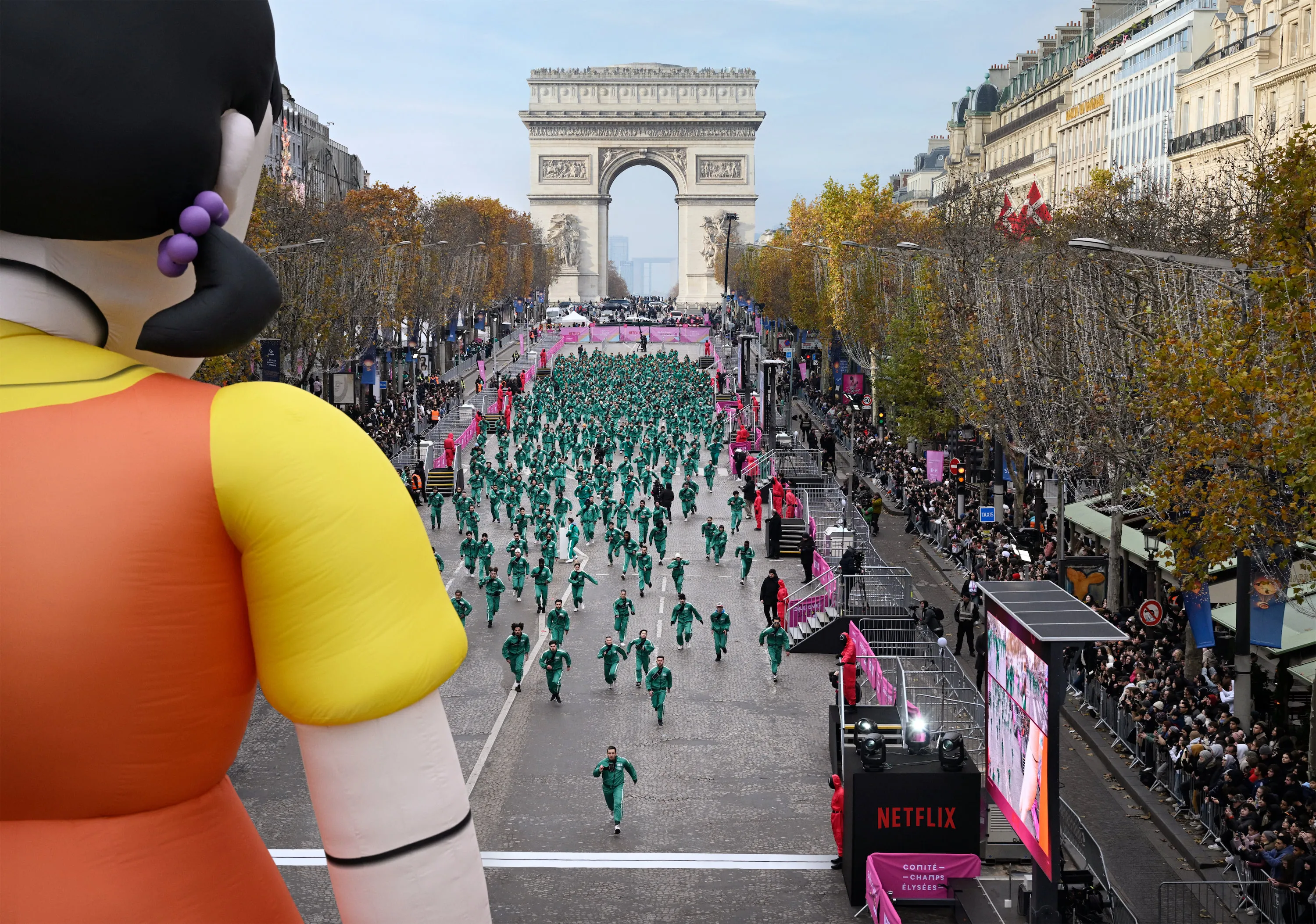
To celebrate the highly anticipated second season of Squid Game, Netflix brought the hit series to life on the Champs-Élysées in Paris on 1 December 2024.
Words Amanda Whitley
In a warehouse-sized dance studio in northern Seoul, a dozen teenagers move in perfect synchronisation, their choreography precise enough to satisfy an Olympic coach. They’ve been rehearsing for hours, and they’ll rehearse for hours more—not just dance, but media training, language lessons, even how to project “good personalities.”
Welcome to the world of K-pop, where cultural dominance is manufactured with the precision of a Samsung smartphone.
But K-pop is just one wave in the hallyu tsunami that has swept across the globe. Twenty-five years after a Chinese newspaper first coined the term “Korean Wave” to describe the phenomenon of Korean cultural exports, hallyu has evolved from a regional curiosity into a global force worth an estimated USD $12.3 billion to the Korean economy.
From the Oscar-winning brilliance of Parasite to the billion-view phenomenon of Gangnam Style, from the fermented depths of kimchi to the 10-step skincare routines that have revolutionised beauty counters worldwide, Korean culture has achieved something remarkable: it has made a nation of 51 million people culturally unavoidable.
Australians have an unprecedented opportunity to explore this phenomenon as the National Museum of Australia presents Hallyu!, a major exhibition examining the Korean Wave’s extraordinary rise and global impact.
“It’s a movement,” says Craig Middleton, Manager of Programming for the exhibition. “You see people dancing in shopping malls, filming themselves. It’s incredibly broad—technology, music, dance, fashion, food. It all intersects.”
“You see people dancing in shopping malls, filming themselves. It’s incredibly broad—technology, music, dance, fashion, food. It all intersects.”
From Crisis to Cool
The Korean Wave didn’t emerge from prosperity—it was born from crisis. When the 1997 Asian financial crisis devastated South Korea’s economy, forcing the government to accept a humiliating USD $57 billion bailout from the IMF (a day still remembered as the Day of National Humility), something shifted in the national consciousness. President Kim Dae-jung looked at the economic carnage and decided Korea needed a new strategy.
“Kim marvelled how much revenue the United States brought in from films and the UK from stage musicals,” journalist Euny Hong writes in her book The Birth of Korean Cool. “He decided to use those two countries as benchmarks for creating a pop culture industry in Korea.”
The government threw billions into a new Cultural Content Office, backed by a massive public-private investment fund. The mission was audacious: rebrand an entire nation through creative exports. As Martin Roll notes in his analysis of the Korean Wave, the strategy inverted traditional soft power dynamics: “In the past, effective ‘soft power’—notably, the cultural exports of Britain and the US—followed on from economic empire building. The Korean model, by contrast, was ‘culture first, economics second.’”
It worked spectacularly. By 2024, according to Korea’s Ministry of Foreign Affairs, there were 225 million hallyu fans worldwide across 119 countries. Netflix recently announced $2.5 billion in investment in South Korean projects over four years, with Disney Plus and Apple TV following suit.
The Mechanics of a Movement
What makes hallyu different from previous cultural exports is the strategic precision behind it. K-pop, the movement’s most visible ambassador, operates more like a tech startup than a traditional music industry. Companies like SM Entertainment and Hybe don’t just sign talent; they manufacture it with almost algorithmic efficiency.
“One of the things we tell [new talent] is that they are representing our country,” Chris Lee, CEO of SM Entertainment, told journalist Tim Adams for The Guardian. “If you were on an Olympic team you would have to be trained and we see no difference.”
The training is intense. Young recruits—some as young as 11—sign long-term contracts and essentially live in their management company’s buildings, studying languages, media presentation, choreography, and vocal technique. The production quality is Hollywood-level, but the accessibility is pure social media age. K-pop idols maintain near-constant contact with global fan communities through digital platforms, creating a sense of intimacy that traditional pop stars rarely achieve.
“It’s inclusive, highly engaged, joyful,” Middleton observes of the K-pop fan culture. “The diversity of the audience—across age, across cultural backgrounds—it’s really remarkable.”
But as the University of Melbourne’s Natalia Grincheva notes in her research, K-pop’s demographic reach extends far beyond what many expect. According to her Hallyu Tracker analysis, countries with “zero direct Hallyu imports”—including Middle Eastern nations like Oman, Qatar and Kuwait—show high compatibility with Korean cultural products, particularly among younger populations.
“These countries score very highly for Hallyu compatibility thanks to the median age of their populations,” Grincheva explains, revealing untapped markets where Korean culture could thrive.
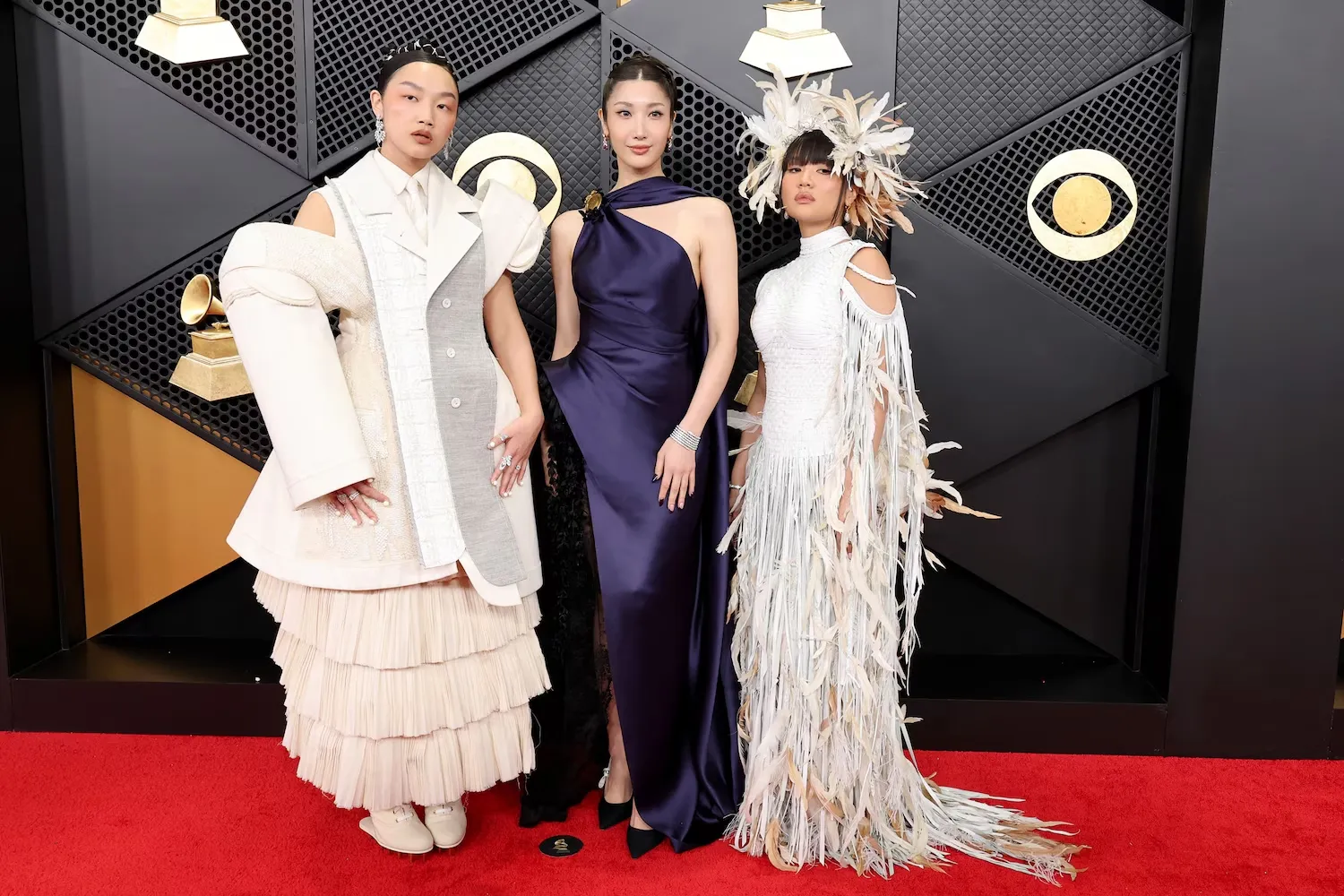
Audrey Nuna, EJAE and Rei Ami of Kpop Demon Hunters attend the 68th GRAMMY Awards at Crypto.com Arena on 01 February, 2026 in Los Angeles © Sussman/Getty Images
Beyond the Boy Bands
While K-pop captures headlines, the Korean Wave’s most sophisticated achievements may lie in film and television. Bong Joon-ho’s Parasite didn’t just win the Oscar for Best Picture in 2020—it became the first non-English language film to do so, a watershed moment that proved global audiences were hungry for stories that Hollywood had stopped telling.
“While Hollywood repeats ever-more bloated Marvel franchises,” Adams writes, “Korean film-makers have learned that 1970s Hollywood trick of making thoughtful, auteur-led films go mainstream.”
Parasite succeeded not through any compromise to Western tastes but through “brilliant contemporary storytelling, the sharp and resonant things it had to say about inequality and class and poverty and excess—subjects about which mainstream American film is mostly silent.”
The success continued with Netflix’s Squid Game, which became the platform’s first non-English show to top global viewing charts, clocking 1.65 billion hours in its first month—more than double the previous record holder, Bridgerton. The show’s brutal examination of late-stage capitalism, wrapped in the aesthetics of children’s games, proved that Korean creators had mastered a tone of voice entirely their own.
KPop Demon Hunters has ridden the crest of the Korean Wave, becoming Netflix’s most-watched film ever. Accumulating around 500 million views since its release in June 2025, its success has extended far beyond the small screen, selling out cinemas, lifting Netflix’s revenue by 17%, and snagging both a Golden Globe and Grammy for its original song Golden.
KPop Demon Hunters has ridden the crest of the Korean Wave, becoming Netflix’s most-watched film ever.
Tradition Within Innovation
For all its technological sophistication and global reach, hallyu also draws deep from Korean tradition. Take kimchi, the fermented cabbage dish that has become a global superfood phenomenon. Chef Shim Young-soon, 84, has spent five decades collecting regional kimchi recipes dating back to the 15th century. “It was kimchi—fizzing and fermenting in clay pots underground—that got Korea through the harshest winters of its war-torn history,” Adams recounts.
During COVID-19, Korean food’s reputation for health benefits went viral alongside K-pop, with Korean restaurants proliferating in major cities worldwide. In Australia, Korean cuisine has moved far beyond niche status.
Major retailers like Mecca and Sephora now prominently feature Korean beauty brands including Dr. Jart, Sulwhasoo, Innisfree, and Laneige, according to the Australia-Korea Business Council (AKBC).
“The rise of the Hallyu wave in Australia, marked by the popularity of Korean media, cuisine, and beauty products, has not only bolstered the Australia-Korea economic relationship by opening new avenues for trade and collaboration but also significantly enhanced Australians’ familiarity with Korea,” the AKBC notes in their analysis of Korean soft power’s growth in Australia.
The Wave Continues
As Korean culture becomes increasingly omnipresent, it’s worth asking what makes this wave different from previous cultural exports.
Perhaps it’s the timing. Korea’s rise coincided with the social media revolution, allowing fan communities to form globally and instantly. Perhaps it’s the content itself—Korean creators seem unafraid to tackle inequality, mental health, and social pressure in ways that resonate across cultures. Or perhaps it’s simply that in an increasingly homogenised global culture dominated by American franchises, Korean culture offers something different: sophisticated production values married to distinctive storytelling, traditional wisdom filtered through technological innovation, emotional depth combined with visual spectacle.
Whatever the reasons, hallyu shows no signs of receding.
“The growth of the Korean Wave over the past two decades has been fascinating, and it is still unfolding,” writes Martin Roll. “Moving forward, it will be interesting to see how Korea continues to innovate and tap on the massive potential and popularity of the Korean Wave to sustain its appeal to global audiences.”
For Australians curious about this phenomenon, the Hallyu! exhibition offers a chance to explore not just the products of the Korean Wave—the music, films, fashion, and food—but the movement itself. “It’s about community,” Middleton reflects, describing hallyu’s inclusive and joyful nature as people come together across cultural and generational divides.
Twenty-five years after that Shanghai newspaper first identified the Korean Wave, what began as a regional trend has become a global force. And if Seoul’s meticulously planned cultural strategy continues to unfold as intended, this wave is only beginning to crest.
Share this article
More from Edition 16

The war on truth
In 2025, Australian journalist Bryce Corbett sat down with a group of mums in Estonia.

From KYLIE to RHODE: Inside the billion-dollar celebrity beauty boom
It’s hard to name a celebrity who hasn’t entered the beauty space. From Gwyneth Paltrow’s LA luxury wellness brand, synonymous with a more left-of-field approach to beauty, to Hailey Bieber’s clean-girl aesthetic-driven cosmetics company, it seems that celebrities can’t resist getting into the beauty boom.

How Ozempic is rewriting the rules of weight loss
Isabella Raso, Nutritionist and Founder of B.FIT